Can You Clean Air Purifier Filters?
Many individuals focus on the efficiency of air purifiers with little understanding of how to clean air purifier filters. Manufacturer instructions are particularly important when it comes to cleaning the filters. Some filters defined as HEPA are not made to be washed, while others can be washed. These filters should simply be vacuumed or replaced. Overcleaning filters or not cleaning them to the manufacturer’s definition adds to the damage and reduces the filters’ overall effectiveness.
How To Clean Air Purifier Filters–Guide to clean air purifiers
1. First Find your filter type
Washable filters can be washed, or are considered pre-filters, or permanent pre-filters defined as foam filters, or metal mesh pre-filters. In these cases, feel free to clean or vacuum with water.
Non-washable filters, particularly True HEPA filters, are not made with washing in mind. Cleaning through extreme measures like pressure spraying them, dishwashing them is counterproductive and only damps filter efficiency.
Disposable HEPA & carbon filters. These should not be attempted to be washed. Consider replacing them.
2- How To Wash or Clean Permanent Filters
If the air purifier uses HEPA filters, the following filters can be used along with the following instructions.
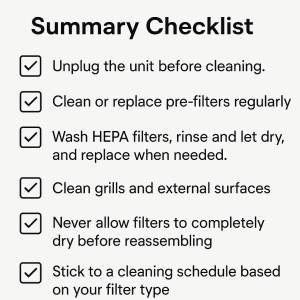
First, switch the power off and unplug the unit, and move it to an accessible location.
Scrub away dust on the air outlet (usually in the back or on the top) using a soft-bristle brush.
Take out the front grill as indicated in the purifier’s manual (many have a pull tab). If deeper cleaning is needed, you can soak this grill in warm water or a mild soap solution.
If your model states that the filter is water-safe, you may wash the rest of the filter with warm or hot water or soak dirty filters. It must air dry completely before reinstallation.
If the filter is a non-washable permanent HEPA filter, dust must be removed using a vacuum cleaner only. Water must be avoided as it may damage the filter
The filter and front grill can be reinstalled, and the exterior of the purifier may be cleaned with a dry or slightly damp microfiber cloth.
Optional: For light cleaning, you may blow dust on both washable and permanent filters, although it must be done with care.
3-How to clean a Disposable Filter Air Purifier
For purifiers with disposable filters:
Plug the device and move it to a convenient area.
Using a soft brush, gently wipe any dust and debris away from the louvres of the purifier.
Remove the front grill and clean it if necessary.
Take out the old filter and reinstall it with a new filter that is approved by the manufacturer.
Put back the front grill, clean the outer surface, and switch the power back on after the purifier is reassembled.
Note: Any carbon filter on the purifier can be rejuvenated by sunning it for 2-3 hours, but it should not be washed or vacuumed.
Related Article: Does an Air Purifier Help with Carbon Monoxide?
How To Clean Air Purifier Filters (HEPA – Levoit)
HEPA filters can be cleaned by these simple method.
1. Pre-filters (Washable)
Levoit devices usually come with foam pre-filters designed to capture bigger particles and avoid clogging of the main filter.
You can wash the pre-filter—usually with lukewarm water and soap—and it is important to clean it every week, optimally, for filter longevity. The pre-filter should be air-dried completely before affixing it back to the device.
I have a Levoit purifier, and the filter comes with a foam pre-filter that you are supposed to wash weekly. (Reddit)
2. Non-Washable HEPA and Carbon Filters
Don’t wash them. Those filters are sensitive filters that would become poorly aligned or damaged if exposed to moisture.
Instead, use the vacuum cleaner with a soft brush attachment to remove surface dust if necessary, though it is best to avoid periods of dust accumulation in the first place. Ultimately, replacement is the best option for seamless performance.
The only recommended way to clean the Levoit air filters is to vacuum them. … I’ve also read that HEPA air filters aren’t designed to be cleaned in the first place.” (Reddit)
3. Cleaning Frequency & Replacement
Pre-filters: vacuum or wash every 1–3 weeks.
Carbons and 3-stage filter systems: Replace after 6 to 12 months of use, based on model and applicability in use. For other monitors, use the Ideal Home model. For them, the time interval could be as low as 4 months.
Exterior & Interior Maintenance
- Every 2–4 weeks, wipe down outer surfaces with a damp microfiber cloth
- avoid water entering the vents. Use a soft brush for stubborn dirt.
Annually (deep clean):
- Unplug and move purifier to open area.
- Vacuum grills, intakes, and interior areas carefully.
- Wipe inside/outside with damp cloth and mild detergent.
- Dry fully, then run the unit on high for 30–60 minutes to confirm proper airflow.
5. Filter Indicator Light
- Many Levoit purifiers feature a “Check Filter” indicator that lights up after the recommended lifespan—usually between 6–12 months. Replace filters when it activates.
Summary Table: Levoit Air Purifier Filter Care
| Component | Cleaning Method | Frequency |
| Pre-filter | Wash with warm water + soap; fully dry → insert | Weekly (or vacuum 1–3 weeks) |
| HEPA / Carbon Filters | Gently vacuum only; replace with new filter | Replace every 6–12 months |
| Exterior Surfaces | Wipe with damp microfiber cloth + soft brush | Every 2–4 weeks |
| Interior (Deep Clean) | Vacuum + wipe + dry; test airflow afterward | Annually |
| Filter Indicator Light | Monitor for replacement prompt | Replace when light activates |
Related Article: Can an air purifier help with mold?
Reasons You Should Never Wash a HEPA Filter
Here are the reasons to avoid washing HEPA filters.
-
Tears and Distortion Wedging
HEPA filters utilize a precise and dense array of fibers (mostly fiberglass or similar) woven together to capture 99.95–99.97% of particles for ultra-fine filtration at 0.3μm (Wikipedia). Water washing is capable of deforming or shrinking this fine-woven mesh, which compromises the HEPA filter itself. It also interferes with the filter alignment and the airflow, resulting in gaps in the system wherein unfiltered air is allowed to bypass the filter .
- Lowered Filtration Touch
As the reports of Air Purifier First noted, washing a HEPA filter results in the overall efficiency dropping between 15% and 23% . Even the slightest washing or cleansing of the filter proves to reduce performance on a large scale.
- Increased Chances of Mold
If the filter is not allowed to air-dry completely, which can take over 24 hours, the filter is compromised, and moisture will promote the chance of mold. Not only does mold stop the filter from capturing unclean air, but it also poses health threats
- Less Effective is Vacuuming
Dropping a HEPA filter can also have unseen consequences. One study recorded a small drop in filter performance for HEPA filters post-vacuum, and reiterates that without using a vacuum to remove the filter, there is no way to restore the filter’s performance. Therefore, in the end, the only thing that can be done is to replace the filter
- Filter Bypassing and Airflow Breach
Concerns regarding bypass filtration have to do with any damage to the filter mesh or frame, which creates leakage routes. Air tends to bypass filtration and gravitates to the path of least resistance, and hence, the purpose of HEPA filtration is defeated.
- Cleaning Airborne Pollution
The relaxation of the filter, especially by vacuuming and shaking, is able to liberate the already stored pollutants which you are trying to eliminate. Not without protective gear, this technique is done outdoors, for you are freely inhaling the worst kind of fibers and particulate matter, and then trying to improve the pollution indoors.
What You Should Do Instead
| Maintenance Task | Recommended Approach |
| Pre-filters | Clean or wash regularly to reduce load on HEPA filter |
| HEPA filters (non-washable) | Do not wash; vacuum gently only if absolutely necessary, but replacement is ideal |
| Regular replacement | Follow manufacturer’s schedule—typically every 6–12 months for residential use |
| Cleaning air inlets & housing | Wipe with a damp cloth to remove dust buildup |
Pre-filters capture larger particles, greatly extending HEPA life if maintained properly
Proper alignment and sealing of the filter within the purifier is vital—ensure the frame and gaskets stay intact to avoid leakage
How Often Should Filters Be Cleaned or Replaced?
Here’s a general schedule to keep your air purifier performing at its best:
| Filter Type | Cleaning Method | Frequency |
| Washable HEPA | Wash (if model allows) | As needed; ensure fully dry |
| Permanent (non-washable) HEPA | Vacuum only | Every ~3 months; replace when worn |
| Disposable Filters | Replace | When indicated or per schedule |
| Carbon Filters | Sunlight for odor removal | Every 3 months; do not wash |
Why Regular Maintenance Matters
Efficiency: Clean filters increase the ease of air flowing through the purifier.
Prevention of damage: Immediate drying of the filter after washing stops mold from growing.
Longevity: Regular attention improves the filter and the purifier life.
Air quality: The more replaceable filters can trap more allergens, dust, and pollution.
Related Article: Can I Leave the Air Purifier On 24/7
How to clean a Xiaomi (Mi) air purifier filter.
Let’s outline the steps below with some insights and more effective practices.
How to Clean the Filter of your Mi Air Purifiers-Main Steps
Detachment of the filter from the Xiaomi Mi Air Purifier
Dust and debris should be removed from the filter. For this part of the process, a vacuum or compressed air is effective.
More detailed maintenance, especially for newer models like the Xiaomi Smart Air Purifier 4:
Fan Blades & Air Duct Cleaning:
Loosen the screws, and the grille can be opened to allow access. Dust now and then with a vacuum cleaner or a soft cloth.
Very lightly mop the negative ion emitter with a soft brush or a brushed cloth.
Clean the filter compartment:
Vacuum or use a soft cloth to remove dust. Do not use water or wipe the inside of the compartment with wet clothes.
Cleaning the laser particle sensor:
Carefully pop the sensor door open with a non-sharp object.
Using a gentle blast of compressed air (and not hot air) or a blower, clean the sensor filter.
For stubborn residue, gently scrub with a toothbrush dipped in clean water, then dry fully before reassembling.
Filter Life and Replacement:
Xiaomi estimates filter lifespan between 6 and 9 months, and it works on a shorter timeline in more polluted environments.
When the filter life drops below 10%, you may reorder filters through the Mi Home application.
Summary for Maintenance Tasks
Set Xiaomi Purifiers: Files with ethos/ respiratory filter sets and their removable Binder Divisor sets for audio nutrients and standard headphone dry out backward glosses.
Reserved for electronic guides and operational deployment in respiratory ventilation guides/charge disks.
Discharge pipes: Reserve for dusting and operational deployment in headsets and other listening guides.
Headphones: Round guides filter set more every 6-9 months, rotate.
There’s been a recommendation for the DIY Xiaomi Air Purifier 4 Compact and how to remove the filter set.
First, in the operational use props- head rest set down and backwards turn left after a long hinge and open screw bag close to pink taped index.
Tip: Do try to rinse the filter with water and vinegar, and use the Lexus Ionizer Set for this, along with the digital air gage diffuser, to speed up air drying for faster use/ rinse drying.
Wrap Up Notes:
Remember to remove guides for air dosers and always use a lid.
To ensure optimal operation, regularly clean internal sections like air ducts and sensors using dry techniques.
Change the filters every six to nine months, or as the purifier demands.
Consult the manual exclusively for your model to know which parts, if any, can be washed. If unsure, the most acceptable option is to vacuum or replace.
Related Article: Can an air purifier help with dust?
Can You Clean a HEPA Filter with Compressed Air?
The short answer would be, no, don’t use compressed air for anything that is a standard HEPA filter that is non-washable.
Let’s Look at Why Compressed Air Does More Harm Than Good
Media Damage
Genuine HEPA Filters are constructed out of highly delicate materials, particularly non-woven glass fibers.
Positive air pressure using a compressor can tear, bend, or create micro-holes to the sensitive structures of the filter media.
Reduced Efficiency
Even the smallest amount of damage to the border of the filter media would seriously affect the constructs of the media, no matter how dense.
Even the smallest of gaps is enough to allow passage of some level of dust, smoke, or allergens, and would thus considerably lower the overall efficiency of the filter.
The Re-Release of Dust
Any form of filter, and with them HEPA filters are no exception to the rule, is constructed for a specific pressure differential. Jumping these predetermined values would result in the filter no longer being useful and even counterproductive.
Can Dyson air purifier filters be cleaned and reused
Typically, HEPA and Activated Carbon filters in Dyson air purifiers can not be cleaned and reused. These filters are made to be replaced once saturated, not washed or rinsed. They can become irreversibly damaged if cleaned, and the efficiency of air purification will be lowered.
Why Dyson HEPA filters can not be cleaned
Small particles
HEPA filters are made with packed tiny fibers that cross and tangle randomly to capture small pollutants.
Ruined by cleaning
This network of fibers is delicate, and once washed or rinsed, it will be broken.
When cleaning the filters by brushing or using compressed air, gaps will be created, and the media will be torn.
Falling below the standard
Once a HEPA filter is damaged, it can be said that it is no longer a HEPA filter, as it can not trap ultra-fine particles such as allergens, bacteria, smoke, and dust. What You Should Do Instead
Follow Manufacturer Guidance
When it is time to change filters, Dyson purifiers issue notifications.
Change Filter
When prompted, turn off and unplug the purifier. Remove the old HEPA/carbon filter and follow the manual to replace it with a genuine Dyson filter.
Maintenance of the Pre Filter (if provided)
Dyson models offer a pre-filter that can be either washed or vacuumed.
Regular cleaning of this filter can increase the longevity of the main HEPA and carbon filters.
Key Takeaway
Dyson HEPA and activated carbon filters are not washable. If notified to replace, replace them. To prolong the filter system’s life, only pre-filters (if available) can be cleaned.
Related Article: Do air purifiers help with a Stuffy Nose
How to Clean Philips Air Purifier Filters
Philips air purifiers have filters of two types.
Pre filter → washable and can be reused.
HEPA and activated carbon filters → non-washable, must be replaced when indicated.
Steps to Clean the Washable Pre-Filter
Switch off and unplug the purifier.
Remove the pre-filter by opening the back panel of the unit.
Pre-filter cleaning steps are:
Dust the pre-filter using a vacuum cleaner or remove it and wash under a tap with slow-running, lukewarm water.
If the pre-filter is heavily soiled, a soft brush can be used to gently scrub it.
Allow it to dry naturally—don’t expose it to heat. Drying it in the sun may not dry it 100%.
Reinstall the pre-filter and replace the back panel.
When to Clean or Replace Other Filters.
Pre-filter cleaning alert.
The purifier will indicate it’s time to clean the pre-filter, or the pre-filter will flash “F0”.
HEPA & Activated Carbon Filters.
These filters are not to be washed, and any attempts to do so will result in the slight fibers being damaged, which will lower the effectiveness of the filter.
You will need to replace the filter. When its designated replacement light turns on on the unit, the replacement intervals are different, depending on the model, usage, and air quality (12-24 months is standard).
After Cleaning or Replacing
Reset Filter Indicator: Using either the filter reset button or the main power button, depending on the model, press and hold the button until the alert light turns off. This action is performed to reset the indicator.
To do so, you will have to examine your model and use it as a reference to the Philips user manual. Other indicators used in different filters may differ in the symbols used, and the reset technique may differ in precision.
The Key Takeaway
Only the pre-filter, which is washable, may be cleaned by either vacuuming, rinsing, or drying.
The HEPA or carbon filters should not be washed themselves, and should be replaced when the purifier indicates.
After any cleaning or replacing, the filter status should reset to the replaced status automatically. Conclusion: Standard HEPA filters that are not marked “washable” should not, under any circumstances, be washed. Washing these filters could result in permanent damage, the quality of air could be decreased, and even worse, it could adversely affect your health. Following maintenance practices will always be more effective in saving time and health: keep pre-filters clean, change HEPA filters on schedule, and gently handle the filter assembly.
Can You Clean Air Purifier Filters? -FAQ
1: Can you clean air purifier filters with water?
Some air purifier filters are washable; however, you should always refer to your manufacturer’s instructions to see if the pre-filter or HEPA filter qualifies as a washable filter.
Washable filters, which consist of pre-filters or specialty types of HEPA filters, must be rinsed until the water runs clear. Still, you should ensure it fully dries before reinstalling them. Non-washable HEPA filters that are washed do become damaged and lose efficacy, which is why they should never be washed.
2: Can air purifier filters be cleaned and reused?
A:No, most standard disposable air purifier filters — especially HEPA filters — cannot be effectively cleaned and reused. The delicate filter media are easily damaged by washing or vacuuming, which reduces their ability to trap particles.
- Why not?
- Fragile filter media: Washing destroys the fine fibers.
- Reduced performance: Efficiency drops even if the filter looks intact.
- Mold risk: A damp filter can grow mold and spread spores indoors.
- When it’s okay:
- Washable pre-filters: Simple mesh filters can be rinsed and reused.
- Some carbon filters: May be rinsed, but their odor-absorbing power fades over time.
Key takeaway: Unless a filter is clearly labeled as washable, assume it’s disposable and replace it according to the manufacturer’s schedule.
3: What are signs of a dirty air filter?
A:Signs depend on whether it’s an engine air filter (car performance) or a cabin air filter (in-car air quality):
- Engine Air Filter Symptoms:
- Reduced power and sluggish acceleration
- Rough idling or engine misfires
- Lower fuel economy
- Check Engine light comes on
- Strange noises (coughing, sputtering, whining)
- Black smoke or fuel smell from exhaust
- Cabin Air Filter Symptoms:
- Weak airflow from AC or heater vents
- Musty or unpleasant odors in the cabin
- Foggy windows that won’t clear easily
- Increased allergens or dust indoors, causing sneezing/irritation
Read More on Air Purifiers