
Why Does a Hygrometer Have a Probe?
A hygrometer has a probe so the sensing element can be placed away from the display and electronics—inside a wall, a duct, a slab of concrete, or across the room—without exposing the sensor to heat from the unit’s own battery and circuitry or exposing the electronics to the harsh conditions being measured. The probe is essentially a remote sensing tip on a cable, letting you separate where the measurement happens from where you read the result.
What’s Actually Inside a Probe
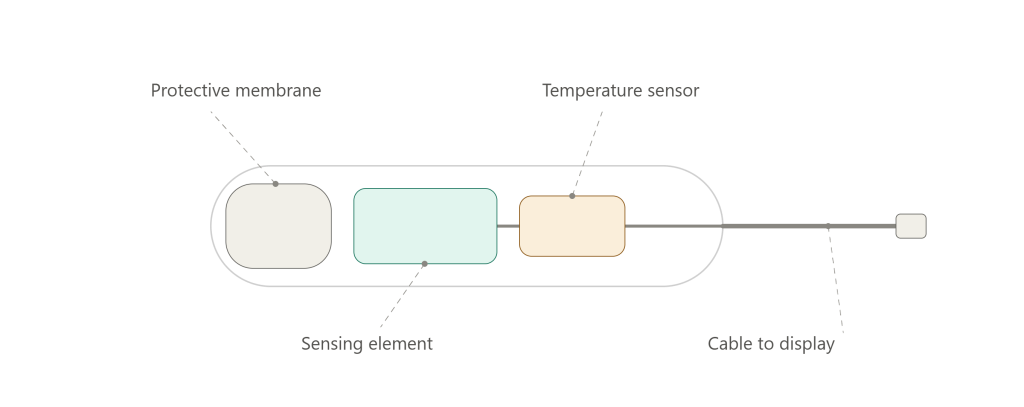
A probe isn’t just a stick with a wire attached—it’s a small, purpose-built assembly:
| Layer | What it does |
|---|---|
| Sensing element | Uses a thin polymer or ceramic film between electrodes for capacitive sensing, a hygroscopic conductive layer for resistive sensing, or a dual-probe pair in nitrogen for thermal-conductivity sensing. |
| Protective membrane | A sintered-metal or PTFE filter cap placed over the probe tip. It allows water vapour to pass through while blocking dust, oil and liquid splashes that could contaminate the sensor. |
| Temperature sensor | Usually integrated beside the humidity-sensing element because relative humidity depends on temperature and therefore requires temperature compensation. |
| Cable and connector | Carries the raw or digitally converted signal to the display, controller or data logger. The cable is often shielded to reduce electrical interference over long distances. |
That membrane detail matters more than most guides admit—it’s the reason probes can survive being stuck into an incubator, a grain silo, or a food processing line without the sensing film itself getting contaminated.
Check out: How humidity sensors work
The Real Reasons Hygrometers Use Probes
1. Access to places a display can’t go
Wall cavities, ductwork, soil, sealed humidors, grain silos—a probe reaches into the space; the display stays somewhere you can actually read it.
2. Avoiding self-heating errors
The main housing contains a battery, a circuit board, and often a backlit display, all of which give off a small amount of heat. Because relative humidity is temperature-sensitive, that heat can quietly skew a reading if the sensor sits in the same housing. Moving the sensor onto a probe, away from the electronics, removes that error source.
3. Protecting the electronics from the environment
Ovens, greenhouses, cold storage, industrial process lines — these are hot, wet, or corrosive environments that a delicate display and circuit board shouldn’t sit in directly. The probe tip is built to tolerate it; the display isn’t.
4. Measuring materials, not just air
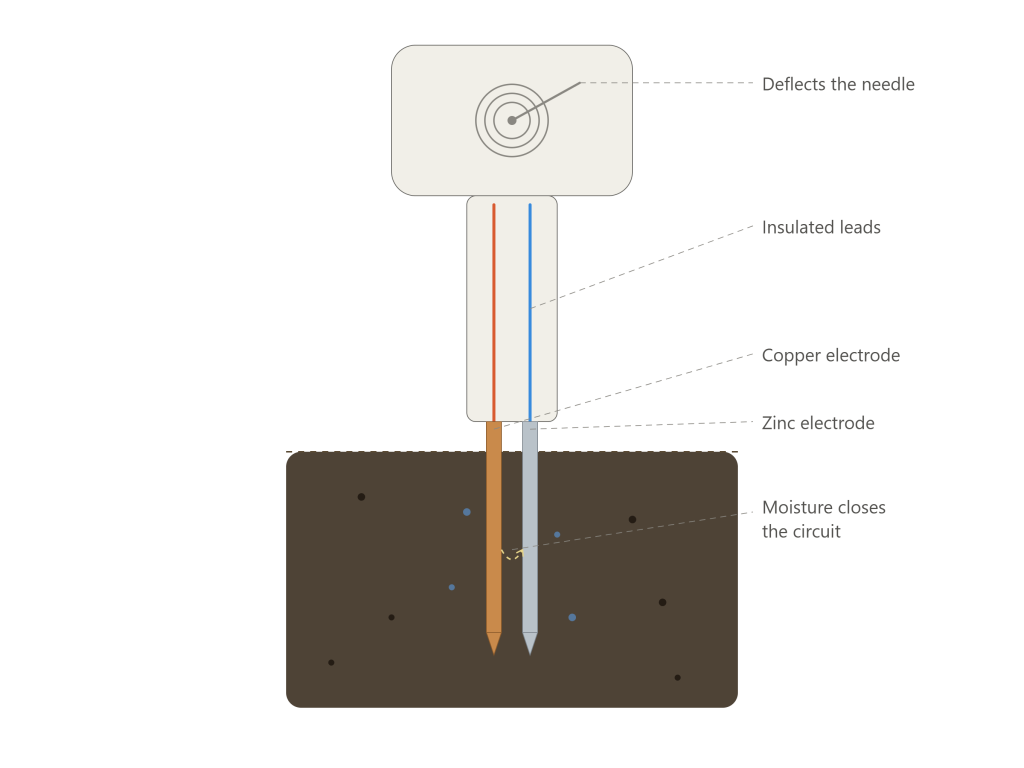
Some probes aren’t measuring air humidity at all—they’re pins inserted into a solid material to read moisture content directly, which is a fundamentally different measurement (more on this below).
5. Multi-point monitoring from one display
Some systems run several probes to different rooms, shelves, or zones off a single central unit—something impossible if the sensor were built into the housing.
Hygrometer With a Probe vs. All-in-One Hygrometer
Most buying guides assume you already know you need a probe. You might not.
| Feature | All-in-One Hygrometer | Probe Hygrometer |
|---|---|---|
| Best for | Measuring room-level humidity where the unit is positioned | Measuring humidity in locations that are inaccessible, hot, wet or physically separated from the display |
| Accuracy risk | May experience slight self-heating errors, especially in tight enclosures | The sensor remains separate from display heat sources, generally improving accuracy in enclosed spaces |
| Typical uses | Living rooms, offices and humidors placed on shelves | Incubators, ducts, wall cavities, soil, concrete slabs, ovens and remote or multi-zone monitoring |
| Cost | Generally lower | Generally higher because of the cable, protective membrane and often more robust sensor |
| Portability | Fully self-contained and easy to move as one unit | The display can remain stationary while the probe is moved or repositioned |
If you’re just checking the humidity of the room you’re standing in, an all-in-one unit is simpler and cheaper. A probe earns its cost when the measurement point and the reading point genuinely need to be different places.
Check out: why hygrometers matter for homeowners?
Air-Humidity Probes vs. Pin-Type Moisture Probes
This distinction gets blurred across most competitor content, and it matters because “hygrometer probe” gets used for two different things:
| Probe type | What it measures | How it works | Typical applications |
|---|---|---|---|
| Air-humidity probe | Relative humidity in the surrounding air | Uses capacitive, resistive or thermal-conductivity sensing to detect water vapour in the air | HVAC systems, incubators, greenhouses, weather stations and environmental monitoring |
| Pin-type moisture probe | Moisture content inside a solid material rather than humidity in the surrounding air | Pins are inserted into materials such as wood or drywall. For concrete, relative-humidity probes are placed in drilled holes and allowed to equilibrate so internal slab conditions can be measured accurately. | Wood, drywall, building materials and in-situ concrete moisture testing |
If your project involves flooring, subfloor moisture, or slab testing, you’re in pin-probe territory, not air-sensor territory—and the two aren’t interchangeable.
Placement and Cable Length Tips
Keep the probe away from direct sunlight, heating vents, and exterior walls — all three will skew local humidity independent of the room average.
Give the probe tip clear airflow; sealing it against a solid surface slows how quickly it reflects real conditions.
Most consumer and light-industrial probes run reliably on cables from a few feet up to around 30–50 feet before signal quality becomes a concern; longer industrial runs typically use shielded cable or a 4–20mA / digital output specifically to avoid interference.
For multi-point setups, stagger probes at different heights or zones rather than clustering them — humidity often varies more by location than people expect.
Troubleshooting a Probe That’s Reading Wrong
Slow or sluggish readings
usually a contaminated or saturated membrane; clean or replace the protective cap.
Drifting over time
most sensing films degrade gradually with exposure to contaminants or extreme humidity; this is a calibration issue, not a fault, and it’s why periodic recalibration matters.
Sudden inaccurate spikes
check for condensation on the sensor if it’s just moved between temperature extremes; give it time to re-equilibrate before trusting the reading.
Consistently offset readings
verify against a known reference (a saturated salt solution is the standard low-cost calibration check) before assuming the probe itself is faulty.
Check out: why hygrometers read inaccurately after high humidity?
Functionality of Probes in Humidity Sensors
In a typical digital hygrometer, the probe does not collect moisture like a container. Instead, water molecules interact with a humidity-sensitive material inside the sensor.
In a capacitive humidity sensor, moisture changes the dielectric properties of a polymer or metal-oxide layer. The resulting change in capacitance is measured electronically and converted into an RH value.
In a resistive humidity sensor, absorbed moisture changes the electrical resistance or impedance of the sensing material. The instrument relates this change to humidity through a calibration curve.
The probe’s temperature sensor is equally important. Relative humidity is highly temperature-dependent, so the sensing element measures the air inside the ventilation system rather than the humidity-sensing element, and the temperature sensor must be exposed to approximately the same conditions.
Temperature differences between the probe and the surrounding air can create significant measurement errors. Professional installation guidance therefore recommends allowing the complete probe to reach thermal equilibrium with the measurement environment.
The instrument then applies calibration coefficients and, where appropriate, temperature compensation before showing the result. Advanced humidity sensor technology may also calculate dew point, frost point, or other moisture quantities from the measured temperature and humidity.
Types of Probes Used in Hygrometers
Probe design varies according to the environment and measurement objective.
| Probe type | Main purpose | Typical applications |
|---|---|---|
| Fixed ambient probe | Measures the air immediately surrounding the instrument | Bedrooms, offices, storage rooms and basic indoor monitoring |
| Remote wired probe | Separates the sensing element from the display or transmitter | Cabinets, incubators, refrigerators, environmental chambers and hard-to-reach spaces |
| Duct probe | Extends into moving air inside ventilation equipment | HVAC ducts, air-handling units and exhaust systems |
| Penetration or insertion probe | Measures humidity or moisture within materials and bulk products | Grain, flour, concrete, binders, environmental chambers and building materials |
| High-temperature probe | Keeps sensitive electronics away from hot measurement conditions | Drying ovens, kilns, packaging chambers and industrial processes |
| Heated humidity probe | Reduces sensor saturation and condensation problems | Near-saturated kilns, dryers and demanding industrial processes |
| Dew-point probe | Measures very low moisture levels or determines the dew point | Compressed-air systems, gas systems and environmental-control equipment |
| Psychrometric probe assembly | Determines humidity using wet- and dry-bulb temperature measurements | Meteorology, HVAC commissioning and reference checks |
| Interchangeable smart probe | Stores calibration data and communicates digitally with compatible instruments | Laboratories, kilns, industrial facilities and multi-probe monitoring systems |
| Wireless probe | Transmits readings without a point-to-point signal cable | Environmental monitoring, packaging applications and distributed monitoring systems |
Insertion probes designed for bulials may have narrow stainless-steel openings that connect kilns and related air traps. Some are intended for clean materials, while more robust designs are made for dusty products, bricks, or concrete.
High-temperature probes use a long probe body or cable to keep vulnerable parts of the commissioning from the hottest part. Industrial models can measure temperatures far beyond the range of an ordinary room hygrometer.
Heated probes address different bulk materials. If the conditions are stainless steel, condensation can trap measurements or make readings unreliable. A controlled probe heater keeps the sensor above the local dew point . Using some additional temperature data , the system determines the actual environmental humidity .
Check out: why some hygrometers have a magnetic mounting dot?
Advantages of Probes
A well-designed probe expands the where and how of using a hygrometer. It’s practical benefits are:
1-Entry into restricted or enclosed areas.
2-Reduced heat interference from the display unit.
3-Better exposure to representative airflow.
4-Faster replacement of damaged single elements.
5-Easier field or laboratory calibration.
6-Protection against dust and liquid droplets.
7-Compatibility with several spoilers.
8-Continuous monitoring without opening a chamber.
9-Simultaneous temperature and relative humidity me
These benefits depend on representative airflow. A high-quality probe placed beside a heater, cold wall, steam outlet, or direct sunlight may provide a less useful result than a modest sensor installed properly.
Enhanced Accuracy of Different Bulk Materials.
A probe can improve the accuracy of a measurement by locating the sensing element where the conditions to be measured actually exist. This distinction is especially important when the display cannot safely or practically be placed at the measurement point.
For example, a remote probe can be positioned:
In the center of an environmental chamber.
Inside an HVAC duct.
Between stored products.
In insulation or behind a wall. Within a greenhouse canopy. In a refrigerator while the display stays outside. * Away from the heat of a data logger. But the probe does not make accuracy on its own. It depends on the entire measurement system which comprises:
Sensor accuracy.
Calibration uncertainty.
Temperature measurement error.
Long-term drift.
Hysteresis.
Data-conversion accuracy.
Probe protection.
Air movement.
Installation depth.
Stabilization time.
Local temperature gradients.
The measurement location should represent the conditions of interest and should be kept away from unrepresentative heat sources, cooling surfaces, direct sunlight, humidifier outlets, and stagnant corners.
Probe temperature is a major source of error. If the probe is colder than the surrounding air, the RH reading may be artificially high. If it is warmer, the reading may be artificially low. Manufacturers therefore advise insulating probe penetrations where necessary and preventing heat conduction along the probe body or cable.
Protection filters also involve a trade-off. A membrane or metal filter can shield the sensor from dust and droplets, but additional material around the sensor may slow vapor exchange. The correct filter should be selected for the expected contamination level and required response time. Some modern pin-type sensors use hydrophobic membranes that provide dust and liquid protection while attempting to preserve RH response performance.
Improved Response Time
A probe can improve response time when its sensing element is directly exposed to representative airflow and thermally separated from the larger instrument housing. A narrow probe normally reaches environmental temperature faster than a heavy display enclosure.
The response time is the time for the sensor to approach a new reading after humidity change. It is usually expressed as T63, which is the time required for the sensor to reach approximately 63% of the way to the final value.
Professional humidity probes may report T63 response times of approximately 15 seconds under specified test conditions, but field response can be slower. Filters, low airflow, cable heat conduction, condensation, probe mass, and temperature differences can all delay stabilization.
A rapid numerical update on the screen does not necessarily mean that the probe has fully equilibrated. The user should distinguish the following:
Display refresh rate.
Electronic sampling interval.
Humidity-sensor response time.
Temperature-sensor response time.
Time required for the complete probe to reach equilibrium.
Research has also shown that different response speeds in temperature and humidity sensors can introduce calculated moisture errors during changing conditions. One study found that a compensation algorithm reduced humidity-ratio errors associated with mismatched time constants by approximately 88.9–97.1% under its experimental conditions. This does not mean every consumer hygrometer achieves that improvement; it shows why coordinated temperature and humidity sensing matters in dynamic environments.
Why does a hygrometer have a probe?-Here Is Why
A hygrometer has a probe primarily to place its humidity sensor at the correct measurement point. The probe can reach enclosed spaces, isolate the sensor from the display’s heat, improve exposure to airflow, protect the sensing element, and support specialized applications.
The question “why does hygrometer have a probe?” therefore has no single mechanical answer. Different probe designs solve different measurement problems. A bedroom monitor, HVAC instrument, material-moisture meter, and industrial dew-point transmitter may all use probes, but those probes are not interchangeable.
Probe design can improve measurement quality, yet it cannot compensate for poor calibration or careless positioning. Reliable humidity measurement requires the following:
- A sensor suitable for the expected humidity and temperature range.
- A representative measurement location.
- Good ventilation.
- Enough time for equilibration.
- protection from contamination and condensation.
- Check/calibrate periodically.
- Interpretation of accuracy and resolution.
Why does a hygrometer have a probe?–FAQ
1-Can a hygrometer work without a probe?
Yes, many consumer hygrometers have the sensor built directly into the housing. A probe is only necessary when the measurement point needs to be separate from the display.
2-How long can a hygrometer probe cable be?
It depends on the sensor’s output type. Analog signals typically hold up well to around 30–50 feet before needing shielded cable; digital or 4–20 mA outputs can run much longer without signal degradation.
3-Does a hygrometer probe need calibration?
Yes. Even high-quality probes drift over months of use, especially with exposure to contaminants or extreme humidity, so periodic recalibration against a known reference is standard practice.
Check out how to calibrate a hygrometer?
4-Why is my hygrometer probe giving inaccurate readings?
The most common causes are a contaminated protective membrane, condensation on the sensor after a temperature change, or a probe that’s overdue for calibration.
5-What’s the difference between a humidity probe and a humidity sensor?
The sensor is the small component that actually detects moisture (the capacitive or resistive element). The probe is that sensor housed in a protective casing on a cable built to be placed somewhere separate from the display.
References: Why Does a Hygrometer Have a Probe?
| No. | Source and title | Relevance | Link |
|---|---|---|---|
| 1 | Atlas Scientific — “How Do Humidity Sensors & Probes Work?” | Explains how humidity probes detect moisture and why probes are used for targeted environmental measurements. | https://atlas-scientific.com/blog/how-do-humidity-probes-work/ |
| 2 | Protimeter — “Hygrometer Probes: Reusable vs. Disposable Explained” | Discusses different probe types and their use in humidity and material-moisture testing. | https://blog.protimeter.com/blog/hygrometer-probes-reusable-vs-disposable |
| 3 | HengKo — “Difference Between Humidity Probe and Humidity Sensor” | Explains the distinction between a sensing element and a complete probe assembly. | https://www.hengko.com/news/humidity-probe-and-humidity-sensor/ |
| 4 | US Patent 4,345,469 — “Air Tunnel Device for Thermohygrometer” | Supports the claim that instrument heat can affect temperature and humidity readings. | https://image-ppubs.uspto.gov/dirsearch-public/print/downloadPdf/4345469 |
| 5 | AcuRite — “How Does a Hygrometer Work?” | Provides general information about how hygrometers measure atmospheric humidity. | https://www.acurite.com/blogs/measuring-weather/how-does-a-hygrometer-work |
| 6 | ThermoPro — “How to Use a Hygrometer and How Does It Work?” | Explains hygrometer operation, placement and practical use. | https://buythermopro.com/how-to-use-hygrometer-and-how-it-work/ |
| 7 | Rotronic — “Humidity Sensors | Relative Humidity Probes” | Explains plug-in and cable-connected probes for high-temperature and demanding environments. | https://www.rotronic.com/en-us/humidity-measurement-feuchtemessung-temperaturmessungs/humidity-measurement-feuchte-messung/probes-filters |
| 8 | Testo — “Air Humidity Probes” | Shows how narrow probes measure humidity in confined and difficult-to-reach locations. | https://www.testo.com/en-UK/humidity-probes/air-humidity-probes/c/air-humidity-probes |
| 9 | Testo — “Thin Humidity Probe—For Material Moisture” | Describes a 4 mm probe used in recesses, boreholes and materials. | https://www.testo.com/en-UK/thin-humidity-probe-with-built-in-electronics-incl-4-attac/p/0636-2135 |
| 10 | Testo — “Humidity Meter with Outstanding Performance” | Explains the use of external probes in complex and high-humidity industrial environments. | https://www.testo.com/en-SA/products/air-humidity-meter |
| 11 | Vaisala — “Common Humidity Measurement Problems and How to Avoid Them” | Explains why correct probe positioning is necessary for representative readings. | https://www.vaisala.com/en/blog/2024-01/common-humidity-measurement-problems-and-how-avoid-them |
| 12 | Vaisala — “Measuring Humidity in Condensing Environments” | Describes warmed probes used to prevent sensor saturation in condensing conditions. | https://www.vaisala.com/en/blog/2020-10/measuring-humidity-condensing-environments |
| 13 | Vaisala — “Selecting the Right Humidity Instrument for High-Humidity Applications” | Covers probe warming, insulation, installation and sensor saturation. | https://www.vaisala.com/en/expert-article/tips-how-to-select-right-humidity-instrument-for-your-high-humidity-application |
| 14 | Vaisala — “Temperature Measurement” | Presents probes designed for high pressure, high temperature and rapidly changing environments. | https://www.vaisala.com/en/measurement/temperature-measurement |
| 15 | Omega Engineering — “Duct, Wall and Remote-Mount Temperature, Humidity and Dew-Point Transmitters” | Shows why remote probes are used in ducts, chambers and locations unsuitable for the main instrument. | https://mx.omega.com/pptst_eng/HX200.html |
| 16 | Omega Engineering — “Relative Humidity Remote Probes” | Describes a protected remote probe that remains exposed to the air being measured. | https://mx.omega.com/pptst_eng/RH-REMOTE.html |
| 17 | Campbell Scientific — “HMP60 Air Temperature and Relative Humidity Sensor” | Provides an example of a cable-connected probe for long-term environmental monitoring. | https://www.campbellsci.com/hmp60 |
| 18 | Campbell Scientific — “HC2S3-L Temperature and Relative Humidity Probe” | Shows how probes can be positioned in radiation shields to reduce heat and solar-radiation errors. | https://www.campbellsci.com/hc2s3 |
| 19 | Delmhorst — “HT-4000F Thermo-Hygrometer” | Explains how detachable probes measure relative humidity inside concrete slabs. | https://www.delmhorst.com/products/ht-4000f-thermo-hygrometer |
| 20 | Delmhorst — “Testing RH with Your Concrete Moisture Meter” | Explains why an inserted probe is needed to measure internal rather than surface humidity. | https://www.delmhorst.com/blog/testing-rh-with-your-concrete-moisture-meter |


