Why Is There an Iron Dot on the Back of a Hygrometer?
If you’ve flipped over your hygrometer and noticed a small, dark, metallic-looking dot pressed into the back casing, you’re not imagining things—and you’re not alone. It’s a common enough sight that people search for it by name, yet almost no manufacturer explains it on the box. This guide explains the dot’s purpose and its connection to hygrometers and other environmental monitoring devices.
A hygrometer is an instrument that measures relative humidity — the amount of water vapor in the air compared to the maximum the air could hold at that temperature. They show up everywhere: cigar humidors, guitar cases, greenhouses, wine cellars, server rooms, and ordinary living rooms. Some are analog, with a dial and a needle; others are digital, with an LCD readout. Despite the different displays, most share a similar back panel, which is where this “iron dot” question usually starts.
Why Humidity Control Systems Is Must
Humidity control systems rely on accurate hygrometer readings to function correctly. Whether it’s a humidor keeping cigars at 70% RH, a greenhouse regulating moisture for seedlings, or a data center protecting servers from static and corrosion, the hygrometer is the sensing front end for the whole system. If the sensor is misread, mispositioned, or misunderstood — including small design details like mounting hardware — the downstream humidity control system can’t do its job properly.
The Role of the Iron Dot
In the overwhelming majority of cases, what people describe as an iron dot on the back of a hygrometer is a small magnetic disc, embedded or glued into the rear casing during manufacturing. It’s typically a few millimeters wide, dark gray or silver, and slightly recessed or flush with the surface.
Its job has nothing to do with sensing humidity. It’s there so the device can be mounted magnetically to any steel or iron surface—a humidor lid, a refrigerator door, a metal filing cabinet, a workshop wall, or the steel frame of a 3D printer enclosure. Owners of humidors in particular often notice it because they mount the hygrometer to the inside of a metal-lined lid, and the magnet is strong enough to hold the device in place without screws or adhesive.
The dot is magnetic, not the “iron”—the name refers to what it sticks to, not what it’s made of. Most of these mounting magnets are small neodymium or ferrite discs, which is also why they can look dark and metallic rather than shiny.
Historical Context of Hygrometers
Humidity measurement is centuries old. Nicholas of Cusa is credited with an early humidity-sensing concept in the 15th century, and Swiss scientist Horace-Bénédict de Saussure built a hygrometer using a strand of human hair as the sensing element in 1783—hair naturally lengthens and shortens with moisture, which mechanical hygrometers still exploit today in the form of hygroscopic strips or coils.
Mechanical dial hygrometers, the kind most likely to have a magnetic back, generally use a metal coil paired with a moisture-sensitive material; as the material absorbs or releases water vapor, the coil flexes and moves the needle. None of that historical sensing mechanism involves the magnet—the magnet is a modern manufacturing and mounting convenience layered onto an old measuring principle.
Environmental Monitoring Devices
Types of Environmental Monitoring Devices
Hygrometers are one member of a broader family of environmental monitoring devices, which also includes the following:
-
Thermometers — measure temperature, often combined with a hygrometer in one unit
-
Barometers — measure atmospheric pressure
-
Moisture meters — a moisture measurement device used for wood, soil, or building materials rather than open air
-
Dew point meters — calculate the temperature at which condensation will form
-
Air quality monitors—track particulates, VOCs, or CO₂ alongside humidity
Many combination devices, especially compact digital ones marketed for humidors, greenhouses, and closets, bundle a hygrometer with a thermometer and include the same magnetic mounting dot on the back for convenience.
Hygrometers vs. Other Devices
Compared to a general moisture measurement device used on solid materials, a hygrometer specifically measures airborne water vapor rather than moisture trapped inside wood, drywall, or soil. That distinction matters for placement: a hygrometer needs airflow around it to read accurately, which is also why many models include small spacers or vents on the back panel in addition to (or instead of) a magnet—a detail worth not confusing with the magnetic dot, since both can appear on the rear casing.
Why Is There an Iron Dot on the Back of a Hygrometer? -Mechanism Behind the Dot
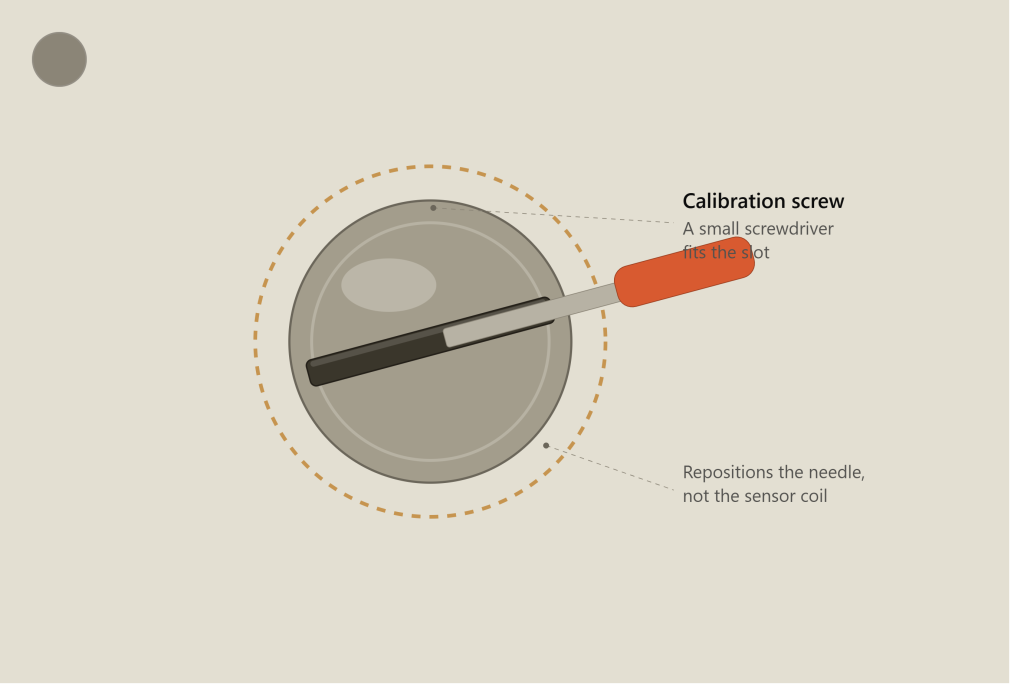
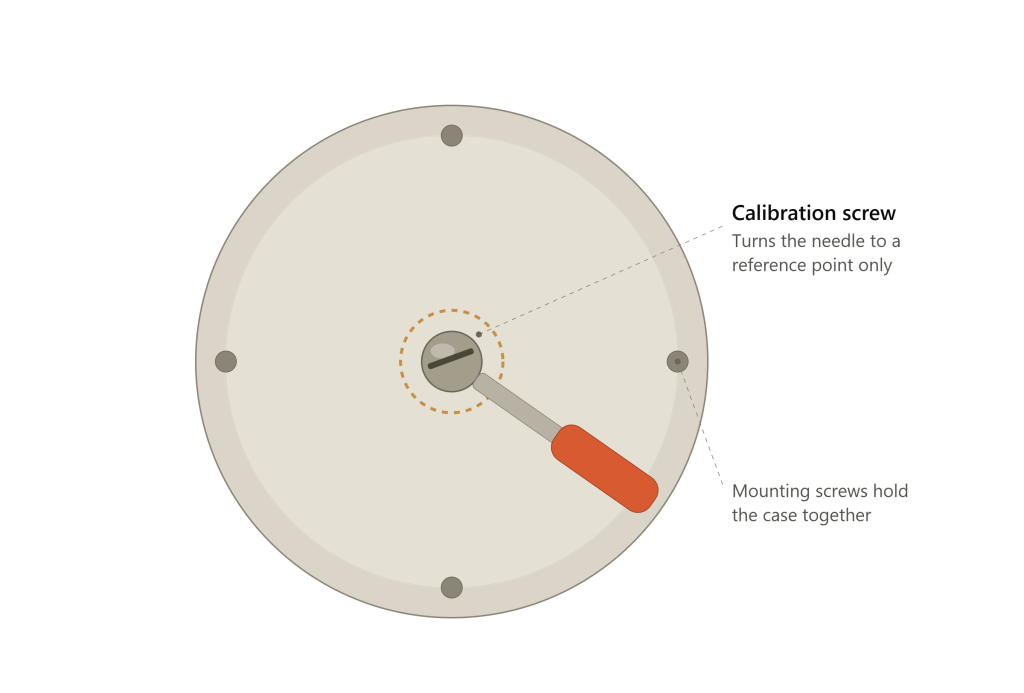
To be direct: there is no verified, published engineering source describing an actual “iron dot” as a functional sensing component inside a hygrometer. What’s well documented, across hygrometer manufacturers, humidor accessory makers, and industrial instrument suppliers, is the magnetic mounting disc described above.
Some industrial-grade thermo-hygrometers used in coatings and construction go further, building in a genuinely strong magnet specifically so the instrument can be held flush against a steel or iron test surface while it stabilizes and takes a reading — a deliberate design feature, not an accident.
So the honest mechanism is straightforward: a small magnet is embedded in the back of the casing during assembly, positioned so it doesn’t interfere with the internal hygroscopic sensor or coil, and finished with a dark, metallic-looking coating that reads as an “iron dot” to the naked eye.
Common Misconceptions
A few misunderstandings tend to circulate around this feature:
-
It’s part of the humidity sensor. It isn’t. The sensing element — whether a hair strand, a coated coil, or a digital capacitive sensor — is a separate internal component. The dot is purely a mounting magnet.
-
It affects the accuracy of the reading. A properly placed mounting magnet shouldn’t interfere with humidity measurement. However, placing the hygrometer directly on top of another magnetic accessory or in a spot where the lid can’t close properly because of the added thickness can indirectly throw off readings—as some humidor owners have discovered the hard way.
-
Every hygrometer has one. Not true. Many hygrometers, especially basic wall-mounted or freestanding models, skip the magnet entirely and rely on a stand, adhesive pad, or screw holes instead.
Why Is There an Iron Dot on the Back of a Hygrometer-Real Reason Disclosed
The iron dot on the back of a hygrometer is, in virtually every documented case, a small embedded magnet used for mounting the device to steel or iron surfaces—not a hidden sensor and not made of iron itself. It sits alongside the instrument’s real humidity-sensing mechanism without playing any role in the actual measurement. Understanding this distinction matters for anyone setting up humidity control systems, since where and how a hygrometer is mounted can affect airflow and, in turn, reading accuracy—while the magnet itself is simply a convenience feature.
Future Trends in Humidity Measurement
As hygrometers increasingly integrate into smart home and industrial IoT ecosystems, expect mounting hardware—magnets included—to keep evolving alongside the electronics. Wireless, app-connected environmental monitoring devices are already blending humidity, temperature, and air quality sensing into single compact units, and manufacturers continue to prioritize easy, tool-free placement (magnetic, adhesive, or clip-on) as a selling point, separate from ongoing improvements in sensor material and calibration stability.
Why Is There an Iron Dot on the Back of a Hygrometer? FAQ
Q: What is the iron dot on the back of a hygrometer?
A: It’s almost always a small embedded magnet, not iron. It is used to attach the hygrometer to a steel or iron surface, such as the lid of a humidor, the door of a fridge or a metal shelf.
Q. The dot is for humidity sensor?
A: No. The actual humidity-sensing element — a coated coil, hair strand, or digital capacitive sensor — is a separate internal part. The dot plays no role in measuring humidity.
Q: Will the magnet affect the accuracy of my hygrometer?
A: No. But if you put it in a place where it blocks airflow or doesn’t allow a lid to close completely it can skew readings. The magnet itself isn’t the problem — placement is.
Q: Why is it called an iron dot if it’s a magnet?
A: The name describes what it sticks to (iron or steel), not what it’s made of. Most are small ferrite or neodymium magnets with a dark, metallic finish.
Q: Do all hygrometers have this dot? A: No. Many wall-mounted or freestanding hygrometers skip it entirely and use a stand, adhesive pad, or screw holes instead.
Q: Where can I find more on hygrometer accuracy? A: See our full guide on why the dot is there and how it fits into humidity control systems, plus our posts on calibrating a hygrometer and best practices for high-humidity testing.
Why Is There an Iron Dot on the Back of a Hygrometer? References
| Source | Link |
|---|---|
| Wikipedia — Hygrometer (history of hair hygrometers, metal-coil dial mechanisms, traditional humidity measurement methods) | https://en.wikipedia.org/wiki/Hygrometer (Wikipedia) |
| The Weather Store — Calibrating Your Hygrometer (analog hygrometer adjustment mechanisms and calibration guidance) | https://www.theweatherstore.com |
| Industrial Physics — TQC Sheen Dewmag Magnetic Thermo Hygrometer (industrial magnetic backing for surface-mounted humidity and temperature readings) | https://industrialphysics.com |
| Weather Station Advisor — Best Hygrometers (magnetic disc mounting applications, including humidor hygrometers) | https://www.weatherstationadvisor.com |
| WeatherSTEM — Types of Hygrometers (metal-paper coil hygrometer operation and limitations) | https://learn.weatherstem.com/modules/learn/lessons/101/10.html (learn.weatherstem.com) |
