Why Is a Hygrometer Inaccurate After High Humidity?
If you’ve ever checked a hygrometer after a steamy shower, a humid storm, or a few days in a damp basement and noticed it’s stuck reading high—even hours after the air has clearly dried out—you’re not imagining it, and your device probably isn’t broken. This is one of the most common and most misunderstood behaviors in humidity measurement, and it happens for a specific, well-understood reason: the sensor inside most hygrometers absorbs moisture faster than it releases it.
That mismatch, known as hysteresis, is the short answer to why a hygrometer is inaccurate after high humidity. The longer answer involves how your sensor is built, how long and how badly it was exposed, and how much airflow it’s had since—all of which this guide walks through, along with how to tell the difference between a sensor that just needs time and one that actually needs replacing.
What is a hygrometer?
A hygrometer is an instrument that measures the moisture content of the air, usually expressed as relative humidity (RH) — the amount of water vapor present compared to the maximum the air could hold at that temperature. Because RH is temperature-dependent, most hygrometers measure both temperature and humidity together and calculate RH from the two readings. This is relevant for accuracy: a sensor that’s off on temperature will also throw off the humidity figure, even if the humidity-sensing element itself is working correctly.
Types of Hygrometers
Not all hygrometers work the same way, and the technology behind yours has a lot to do with how it behaves after high humidity:
Capacitive sensors
are the most common type in digital and smart hygrometers. A thin polymer film absorbs water vapor, which changes its electrical capacitance in proportion to the humidity. This is also the sensor type most prone to the sticky, slow-to-recover behavior this article focuses on.
Resistive sensors
Measure changes in electrical resistance as a hygroscopic material absorbs moisture. They’re common in lower-cost meters and share similar saturation issues, since water can become trapped in the porous sensing film.
Mechanical (hair tension) hygrometers
use a bundle of human or synthetic hair that expands and contracts with humidity, moving a needle. They’re less precise but also less prone to electronic drift, though they can still swell and stick after prolonged dampness.
Psychrometers
(wet-and-dry bulb) calculate humidity from the temperature difference between a dry thermometer and one wrapped in a wet wick, relying on evaporative cooling. They’re mostly used as reference instruments today.
Dew point (chilled mirror) hygrometers
are laboratory and industrial-grade instruments that chill a mirror until condensation forms to provide a direct measurement of the dew point. They are very accurate but expensive and mostly used where accuracy really matters.
How High Humidity Influences Your Hygrometer Reading
Saturation Effects
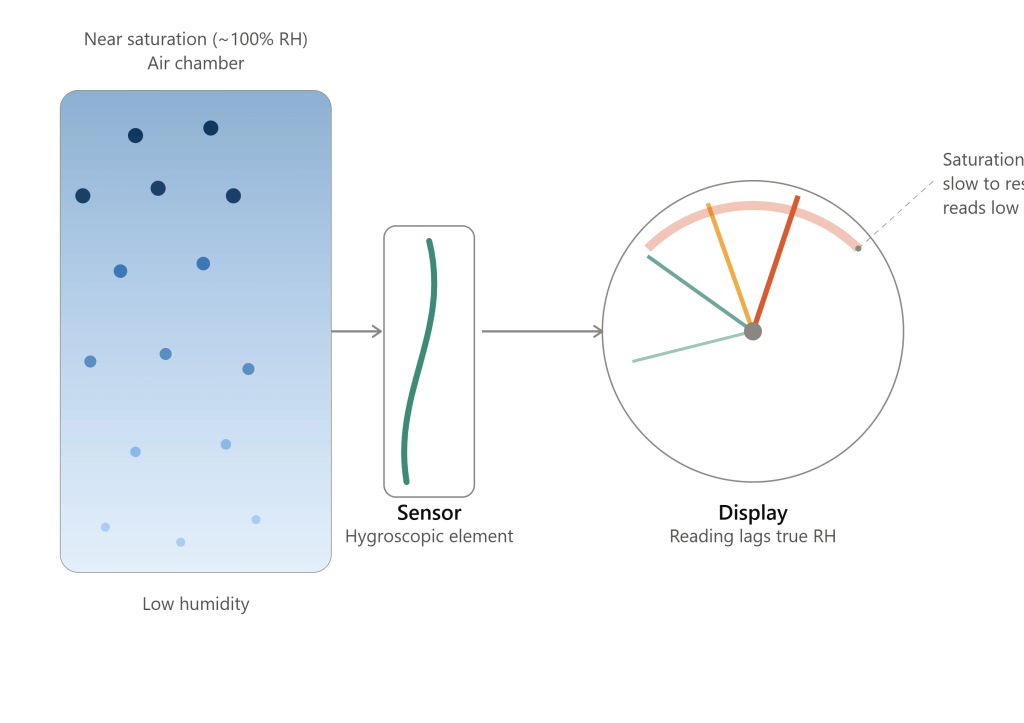
When a capacitive or resistive sensor is exposed to a high humidity level for a long period of time, water molecules do not just settle on the surface but rather penetrate the sensing layer itself. In capacitive polymer sensors, the moisture creates hydrogen bonds between the water molecules and the polymer material that resist breaking apart even after the surrounding air dries out. The sensor is, in effect, still “full” of moisture it hasn’t had time to release.
There’s an important distinction worth making here: vapor saturation (moisture absorbed into the sensing film from humid air) is usually temporary and reversible with time and airflow.
Actual condensation—liquid water forming directly on the sensor from steam, splashing, or being left in a genuinely wet environment—is a different problem that arises when actual condensation forms directly on the sensor due to steam, splashing, or prolonged exposure to a genuinely wet environment.
Liquid water contact can cause lasting structural changes to the sensing material and, in more severe cases, corrosion of the electrical contacts. That’s the difference between “give it time” and “this sensor may need replacing.”
Sensor Response Limitations
Every humidity sensor has both a response time (how fast it reacts to rising humidity) and a recovery time (how fast it reacts to falling humidity)—and for most sensor types, those two numbers aren’t equal. Sensors generally absorb moisture faster than they release it, so recovery consistently lags behind response.
This is why you can walk into a bathroom right after a shower and watch the reading climb in seconds, but watch it take much longer to fall back down once the steam has cleared.
In practice, this can look dramatic: a sensor exposed to a humidity spike may still show a reading in the 80s-percent RH range twenty or thirty minutes after the actual air has already dropped to a much drier level, simply because the sensing film hasn’t finished releasing what it absorbed. How long that lag lasts depends on the following:
Sensor design and material
Some sensing films are engineered specifically for fast recovery; cheaper ones are not
Airflow around the sensor—still air traps moisture near the sensor and slows recovery significantly; a sensor in a closed enclosure or tucked behind furniture will lag far longer than one with open air circulation.
Duration and severity of exposure—a brief spike recovers faster than hours of sustained saturation.**
Ambient temperature—warmer air generally speeds up desorption, while cold, still air slows it down.**
Common Reasons for Inaccuracy
Material Fatigue and Sensor Drift
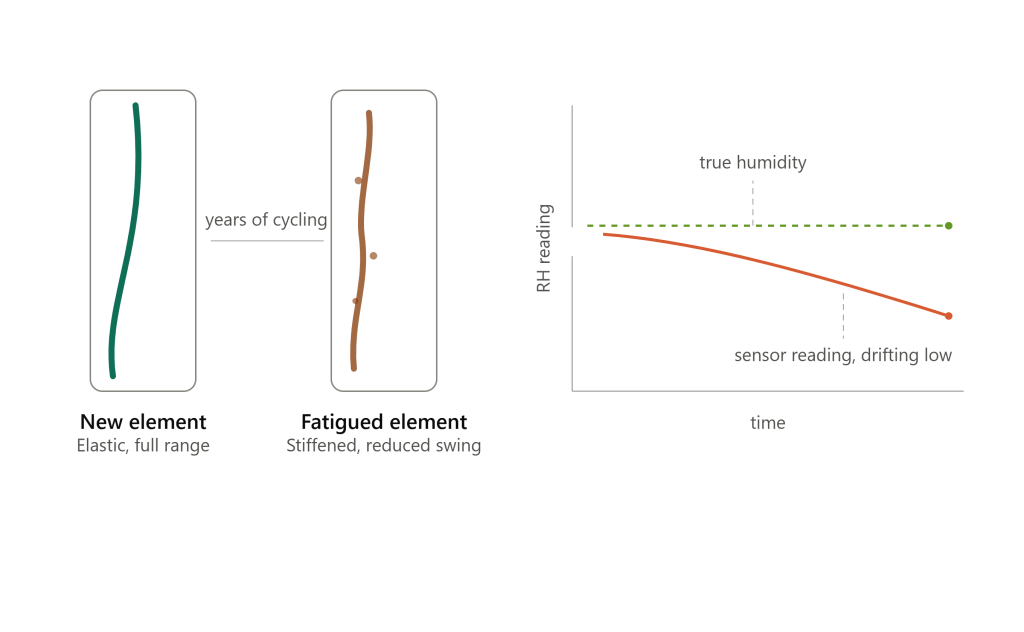
A single high-humidity event is usually a temporary, self-correcting problem. Repeated exposure over months or years is a different story. Each humidity cycle a sensor goes through can leave it slightly less able to fully return to baseline than before, and that cumulative effect is what’s known as sensor drift.
Research on sensor hysteresis has found that it tends to increase the longer a sensor spends at high humidity and high temperature and that a sensor’s prior exposure history genuinely affects how it behaves going forward—the material effectively remembers what it’s been through.
This aging process is compounded by contamination: dust, chemical residue, and airborne particulates settle on the sensing element over time and interfere with how freely it can absorb and release moisture. A sensor that’s been used in consistently humid environments—crawl spaces, bathrooms, greenhouses, restoration jobsites—will typically show more drift over its lifetime than one kept in a stable, moderate environment.
Calibration Challenges Post-High Humidity
One mistake worth avoiding: checking a hygrometer’s accuracy immediately after a high-humidity event and concluding it’s broken. If the sensor is still working through hysteresis-driven recovery, any accuracy check performed during that window will show a false deviation that has nothing to do with the instrument’s actual calibration.
Reputable verification protocols call for letting the setup stabilize in steady conditions—commonly for several hours to a full day—before comparing the reading against a reference standard. Testing too soon after high humidity is one of the most common reasons people conclude a perfectly good hygrometer needs calibration when it actually just needs time.
High Humidity Testing: Best Practices
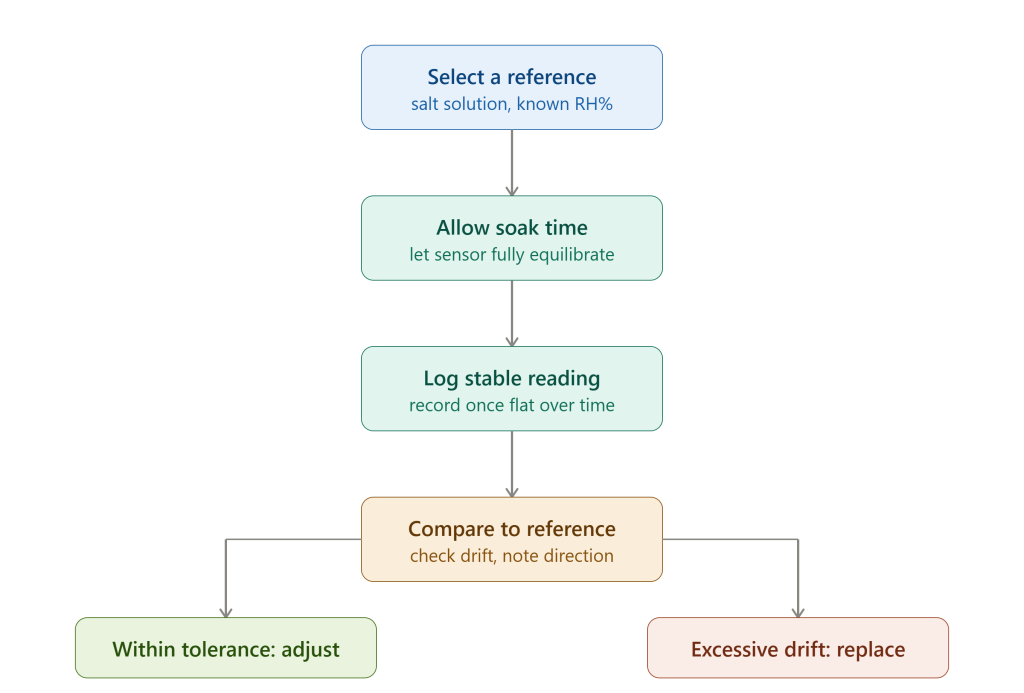
The most accessible way to check whether your hygrometer is reading accurately is a saturated salt test: placing the sensor in a small sealed container with a small amount of table salt dampened just enough to clump (not dissolve), which creates a stable reference humidity of about 75% RH once the setup stabilizes for roughly 8 to 24 hours. Compare your reading to that 75% RH benchmark:
– A variation of about ±3% RH is generally considered acceptable and normal for most consumer- and professional-grade hygrometers.
– ±4–5% RH suggests a minor deviation worth monitoring and possibly a sign the sensor is aging.
– More than ±5% RH** off is generally considered out of tolerance and worth professional calibration or sensor replacement.
If you have access to a second, known-accurate hygrometer, a side-by-side comparison is another straightforward option—as long as both units are placed close together, since even a short distance apart can expose them to meaningfully different micro-conditions.
Optimal Conditions for Testing
High humidity testing and verification should always happen in a stable, draft-free environment, away from direct sunlight, air vents, or doorways. Give the setup time to fully stabilize before recording a result—testing during a temperature swing or right after moving the sensor will introduce error that has nothing to do with the instrument itself.
If you’re comparing two hygrometers, use the same reference method and give both units identical conditions and equal time to settle before comparing their numbers.
Humidity Monitoring Solutions
Choosing the Right Hygrometer
Not every hygrometer is built for the same environment, and matching the sensor to where it’ll actually live matters more than most buyers realize. If you’re monitoring somewhere that regularly experiences high humidity—a bathroom, greenhouse, wine cellar, sauna, or crawl space.
Look for a hygrometer specifically rated for a wide humidity range and fast recovery, rather than a basic model designed for stable indoor rooms. For continuous industrial or building-monitoring applications, some humidity monitoring solutions use heated probes specifically to prevent condensation from forming on the sensor in the first place, which sidesteps the saturation problem entirely rather than just recovering from it faster.
It’s also worth keeping any hygrometer a reasonable distance from direct moisture sources like humidifiers or steam outlets—close proximity causes repeated wetting and drying cycles that accelerate both drift and contamination over the sensor’s lifetime.
Maintenance Tips for Consistent Accuracy
A few habits meaningfully extend how long a hygrometer stays accurate:–
Store it properly
when not in use—a sealed, clean container away from open air limits ongoing exposure to contaminants and humidity swings between uses.
Don’t leave it in extreme humidity longer than necessary
even sensors rated for humid environments benefit from periodic time in more moderate air to fully recover.
Use a protective membrane or cap
if your model supports one to filter contaminants from settling directly on the sensing element.
Verify accuracy on a schedule
roughly every 6 to 12 months for general use, more frequently if the hygrometer is used often in high-humidity conditions.**
Avoid breathing on or holding handheld units too close to your body** when taking a reading, since body heat and breath moisture will skew the result.
Why Is a Hygrometer Inaccurate After High Humidity?- Now Fix
If your hygrometer is reading high right after a humid stretch, the most likely explanation isn’t a faulty device — it’s hysteresis, a normal and well-documented lag between how fast humidity sensors absorb moisture and how fast they release it. Give it time in stable, moving air, and in most cases the reading will settle back to accurate on its own within minutes to a few hours, depending on how severe the exposure was and how much airflow the sensor is getting.
The situation to actually worry about is different: a hygrometer that stays off by more than about 5% RH well after conditions have stabilized or one that was exposed to actual liquid water or condensation rather than just humid air. That’s when it’s time to run a proper verification test and consider calibration or replacement, rather than waiting it out.
Why Is a Hygrometer Inaccurate After High Humidity?-FAQs
What can cause temporary inaccuracies in hygrometers after high humidity?
The main cause is sensor hysteresis—most hygrometers use a sensing material that absorbs moisture faster than it releases it, so after a humidity spike, the reading can stay elevated for minutes to hours even after the actual air has dried out. Poor airflow around the sensor, prolonged or severe exposure, and cooler ambient temperatures all extend how long that recovery takes.
How often should hygrometers be calibrated?
Most manufacturers recommend verifying accuracy every 6 to 12 months for general use, and more frequently — every few months — for hygrometers used regularly in high-humidity or high-use environments. A hygrometer reading more than about 5% RH off from a known reference, even after adequate stabilization time, is generally a sign it’s due for calibration or a sensor replacement rather than just recovery time.
What are the best practices for humidity monitoring?
Place hygrometers away from direct heat sources, humidifiers, air vents, and direct sunlight, and give them time to stabilize in a new location before trusting the reading. Choose a sensor rated for the humidity range you’re actually monitoring, store units properly when not in use, and verify accuracy on a regular schedule using a reference standard like a saturated salt test or a second known-accurate hygrometer placed nearby.
Reference
| Source | Link |
|---|---|
| Protimeter (Amphenol Advanced Sensors) — hygrometer verification, salt-test protocol, calibration checks | https://blog.protimeter.com/blog/how-to-calibrate-a-hygrometer-vs-verify-accuracy (blog.protimeter.com) |
| Delmhorst Instrument Co. — moisture meter calibration and verification resources | https://www.delmhorst.com/blog/moisture-meters-calibration |
| Vaisala — humidity sensor technology, condensation prevention, heated probes | https://www.vaisala.com/en/vaisala-humicap-technology (Vaisala) |
| Vaisala HMP155 — sensor installation, ventilation, condensation prevention | https://docs.vaisala.com/r/M212417EN-M/en-US/GUID-B0EF4F49-FB49-456F-BDC4-05A0535D9A91/GUID-4D91D94D-2595-4596-BB81-8D2FEF28B897 (docs.vaisala.com) |
| Process Sensing Technologies (PST) — humidity measurement technology resources | https://www.processsensing.com |
| Dickson Data — sensor saturation and recovery behaviour | https://dicksondata.com |
| NCBI / PMC — capacitive humidity sensor hysteresis and response behaviour research | https://pmc.ncbi.nlm.nih.gov/articles/PMC6386924/ |
| NCBI / PMC — capacitive humidity sensor characterization studies | https://pmc.ncbi.nlm.nih.gov/articles/PMC8512811/ |
| NCBI / PMC — humidity sensor hysteresis and recovery-time research | https://pmc.ncbi.nlm.nih.gov/articles/PMC7411755/ |